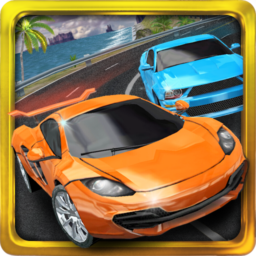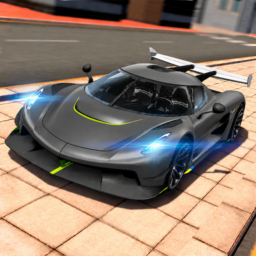


What This Game Actually Offers
Extreme Car Driving Simulator has been around since 2014, and its core pitch hasn’t changed: you get an open-world city where you can drift, speed, crash, and generally ignore every traffic law without cops chasing you down. There’s no mission-based cop chase system or story mode pressure here. Instead you get a sandbox with a checkpoint mini-game mode, a traffic driving mode, a full HUD showing revs, gear, and speed, and toggleable ABS, TC, and ESP simulation. You can steer with a wheel, tilt controls, arrows, or a gamepad, and switch between several camera angles. This is squarely built for people who like cars and free-roam messing around more than structured races, and long-time players in the reviews confirm that’s exactly how it’s used, some say they’ve been playing since elementary school and are now 18.
Where the Driving Feel Shines
The physics engine is the game’s calling card, and it holds up well after all these years. Reviewers repeatedly note that it strikes a balance of being ‘not too realistic, and not too annoying,’ which is a fair description of how the drifting and burnout mechanics feel in practice. Realistic car damage adds a satisfying layer, crashing into things actually deforms your car rather than just bouncing off, and that visual damage feedback is one of the more consistently praised details. Long-term players also highlight that the game keeps getting updated with more missions, collectibles, daily rewards, and customization options, turning what one reviewer called a ‘tech demo’ in 2015 into a much fuller driving sim today.
The Annoyances That Pile Up
The biggest recurring complaint is monetization creep. Multiple reviewers who’ve played for years say the game used to be mostly free and ad-light, but now leans heavily on microtransactions, with car colors and skins locked behind grinding thousands of coins or paying real money. Ad frequency is called out specifically as ‘frustrating,’ even by players who otherwise still enjoy the game. There are also functional gripes: traffic mode AI cars have a tendency to drive straight into your vehicle if you’re standing still, which breaks immersion fast, and at least one player reported a persistent bug where the ‘reach top speed in any car’ daily challenge won’t register as complete, lingering unresolved for months. Performance also reportedly got laggier for some users after updates, which is a rough trade for a game whose main appeal is smooth physics.
Missing Features Players Keep Asking For
A GPS or map system is the single most requested addition across reviews, since navigating the open world without one can get disorienting, especially for players trying to find specific checkpoints or areas. Others want more biomes or a genuinely new area, noting the map hasn’t meaningfully expanded in years despite the game’s long lifespan. There are also requests for deeper customization, like chamber modding, spoilers, and trim options, plus named cars instead of generic models, and a wish to keep legacy vehicle models as separate options rather than overwriting them with updated versions. None of these are dealbreakers, but they show a game that’s aged in some areas while stagnating in others.
Who Should Actually Download This
If you want a low-stakes, no-story arcade driving sandbox where the fun is purely in drifting, crashing, and free-roaming without rules, this delivers exactly that, and the fact that people have stuck with it since 2014 says something about its staying power. It’s also a reasonable pick for anyone who wants console-adjacent controls on mobile, since gamepad and wheel support are both included. That said, go in expecting ads and a monetization structure that pushes you toward spending for cosmetics, plus some rough edges in traffic AI and occasional bugs. If you want structured races, cop chases, or a constantly expanding map, this isn’t built for that. But for casual, physics-driven car messing around, it’s held up better than most games from the same era.